TRIFT™ type analyzer with high tolerance for surface topography
Secondary ions emitted from the sample surface have initial energy and angular distributions. As a result, even ions of the same mass experience differences in flight time. The occurrence of flight time differences leads to degradation of mass resolution.
The Triple Focus Electrostatic Analyzer (TRIFT type analyzer) simultaneously corrects for flight time differences arising from differences in initial energy and emission angle.
The ability to simultaneously correct for flight time differences due to energy and emission angle is the most distinctive feature of the TRIFT type analyzer, enabling both high mass resolution and high detection sensitivity to be achieved simultaneously, as well as imaging with minimal shadowing effects.
Electric field distortion due to sample geometry and secondary ion trajectories
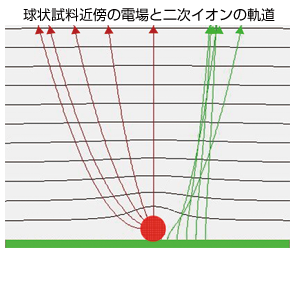
Secondary ions emitted from the sample have initial energy and angular distributions. Especially when the sample geometry is complex, the emission angle is significantly affected by the electric field.
The figure on the left shows the electric field around a spherical sample placed on a flat plate and the trajectories of secondary ions. It can be seen that not only secondary ions emitted from the sample, but also those emitted from the flat plate are significantly deflected by the electric field.
Flight time difference correction by the TRIFT™ type analyzer
The TRIFT type analyzer is capable of canceling out flight time differences caused by initial energy and emission angle.
The figure on the left schematically illustrates the secondary ion trajectories within the analyzer.
The solid black line represents the trajectory of secondary ions with no initial energy. Secondary ions with initial energy travel along the outer path in a manner that cancels out the flight time difference, correcting for the time difference due to energy variation (blue line).
On the other hand, although not shown in the figure, secondary ions that have lost energy due to fragmentation during flight travel along the inner orbit and are removed by the energy filter, resulting in spectra with extremely low background.
Next, secondary ions with angular distribution are described.
Secondary ions with an angular distribution travel a longer distance before entering the analyzer compared to ions without angular distribution, but they take a shortcut path within the analyzer to compensate for this difference (orange line). Those with both angular distribution and initial energy travel along the outer path (red line).
In this way, the TRIFT type analyzer is capable of correcting for flight time differences caused by angular distribution and initial energy.
Therefore, the most distinctive features of the TRIFT type analyzer are: ① independence from sample geometry, ② shadow-free imaging, and ③ no need for special sample preparation such as flattening.
Image of spherical sample using the TRIFT™ type analyzer
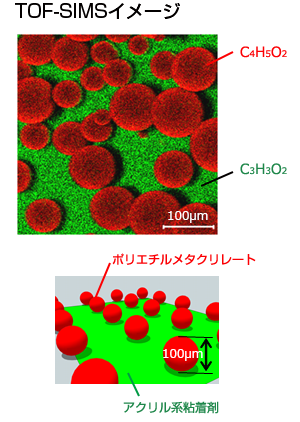
The figure on the left shows a TOF-SIMS image of a sample in which polymer spheres are dispersed on an acrylic adhesive. The imaging is unaffected by the electric field around the sample, enabling shadow-free imaging of the entire surface of the spheres.
Related Instruments Links
Time-of-Flight Secondary Ion Mass Spectrometer TOF-SIMS