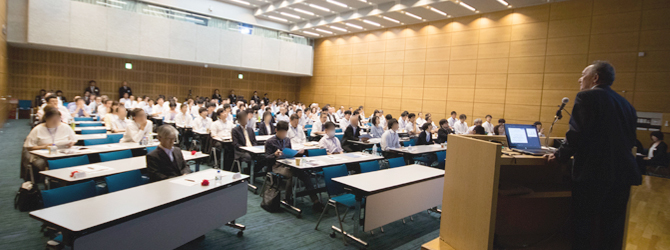
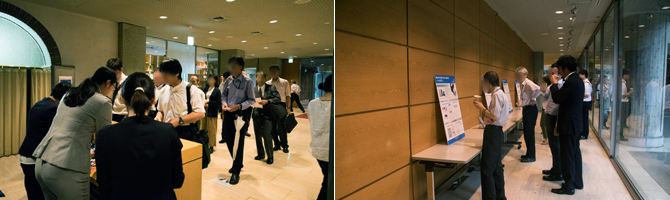
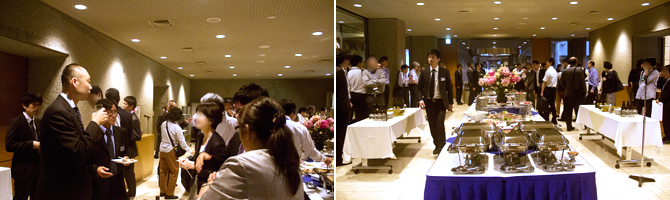
On Friday, June 7, 2019, we held our Technical Symposium at Architectural Institute of Japan Hall (Tamachi, Tokyo).
This year as well, nearly a full house of customers attended, and the event concluded successfully.
The lectures featuring three guest speakers received comments from participants such as “I listened with great interest” and “I would like to apply this to my daily work.”
We would like to once again express our sincere gratitude to the speakers who kindly agreed to present at this event.
> Click here for the program on the day
Lectures
“Extension of Organic EL Device Lifetime and Elucidation of Degradation Mechanisms”
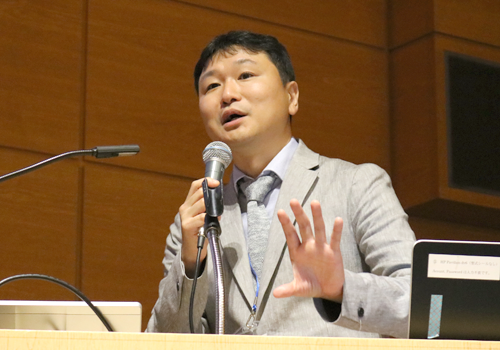
Mr. Hiroshi Fujimoto
Center for Organic Photonics and Electronics Research for Practical Applications (i3-opera)
Fukuoka Industry, Science & Technology Foundation (Public Interest Foundation)
Mr. Fujimoto of the Center for Organic Photonics and Electronics Research for Practical Applications (i3-opera) delivered a lecture titled “Extension of Organic EL Device Lifetime and Elucidation of Degradation Mechanisms,” covering topics ranging from the basic content related to the light-emitting mechanism of organic EL, to efforts aimed at extending device lifetime, and research examples on the actual degradation mechanisms of devices.
The lecture covered very interesting content that led to problem-solving based on objective facts: identifying that trace residual impurities within the deposition chamber of organic EL devices are significantly related to device lifetime, pinpointing the specific substances, and achieving a substantial improvement in lifetime by removing them; as well as discovering a correlation between device fabrication time and lifetime, and being able to obtain stable quality through process improvements.
The importance and role of analytical technology in elucidating degradation mechanisms was also touched upon, and as a member of an instrument manufacturer, we were reminded of our commitment to continue providing even more useful technologies in the future.
“Introduction of Evaluation and Analysis Technology Application Examples in the Development of Functional Materials”
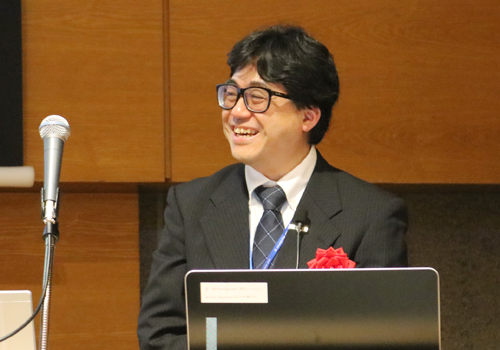
Mr. Mitsuhiro Wada
Evaluation and Analysis Technology Center, Functional Materials Research Institute
Functional Materials Business Division, Mitsui Mining & Smelting Co., Ltd.
Mr. Wada of Mitsui Mining & Smelting Co., Ltd. delivered a lecture titled “Introduction of Evaluation and Analysis Technology Application Examples in the Development of Functional Materials,” describing the process by which actual defect analysis work led to the development of new products and the results achieved.
In the process of clarifying the cause of peeling at the gold wire bonding pad area, the idea emerged to fundamentally reconsider the adhesion mechanism between the electrode and substrate from the ground up, and the solution that was ultimately derived led to an improvement in yield.
What was particularly interesting was that grasping the current situation and formulating hypotheses based on the results of combining AES, XPS, and TOF-SIMS with other analytical instruments became the catalyst for deriving the solution for product development. Hearing this valuable account of how the process of clarifying objectives, grasping the current situation, formulating hypotheses, and elucidating mechanisms led to technological innovation and significant results was a reminder of our responsibilities as those involved in analysis and characterization technology.
“On the Utilization of Analysis Technology in Industry”
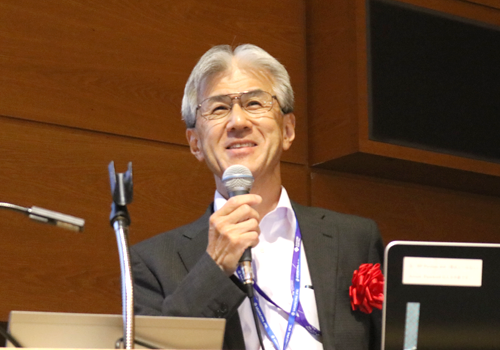
Mr. Akira Yamaguchi
Former Director, Analysis Technology Research Center, Sumitomo Electric Industries, Ltd.
(Currently at the Japan Synchrotron Radiation Research Institute (JASRI))
Mr. Yamaguchi of Sumitomo Electric Industries, Ltd. (currently at the Japan Synchrotron Radiation Research Institute) spoke from his position as Former Director of the Analysis Technology Research Center about the company’s history starting from electric wire and cable, the five business fields (automotive, information and communications, electronics, environmental energy, and industrial materials) developed through the technologies cultivated along the way, and the relationship between these fields and the research, development, and analysis teams that support them.
The lecture content was organized and clearly explained around three main themes: organizational theory, human resource development, and visualization of results. In particular, the following points — which are difficult to sustain yet were maintained and carried through over many years, ultimately leading to significant results — were very well-received by many people involved in management as potential hints for the future: ・ “Since opinions differ depending on one’s position, listen carefully to what the other person has to say” ・ “Have a strong sense of responsibility to solve problems yourself” ・ “In order to properly communicate results to upper management, summarize them clearly on a single A4 sheet and report regularly”
In closing, we would like to express our gratitude for your continued relationship with us from instruments such as the PHI 600 (AES) and PHI 5400 (XPS) from several decades ago right up to the present, as well as for delivering such a valuable lecture at this event.
From ULVAC-PHI
Our Analysis Department presented a lecture titled “Latest Technologies Expanding the Possibilities of Surface Analysis — HAXPES, UPS/LEIPS, MS/MS —,” covering each of the products and options.
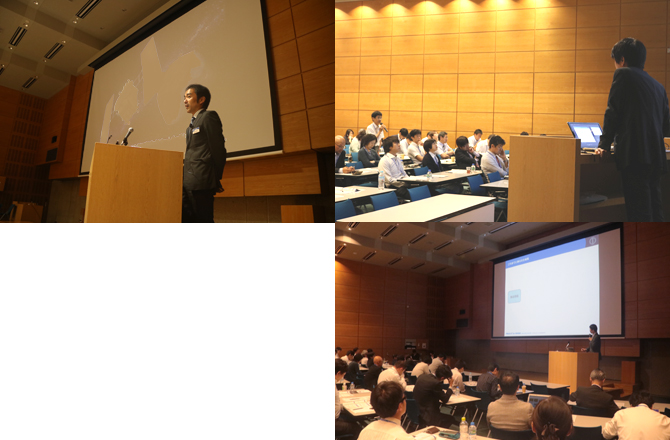
Next, our Technical Development Department presented “Introduction of New Analysis Software Realizing a Comfortable Data Processing Environment and Automation,” introducing the new features and characteristics of new software for XPS/AES data analysis (currently under development) that represents a completely renewed concept from our conventional products.
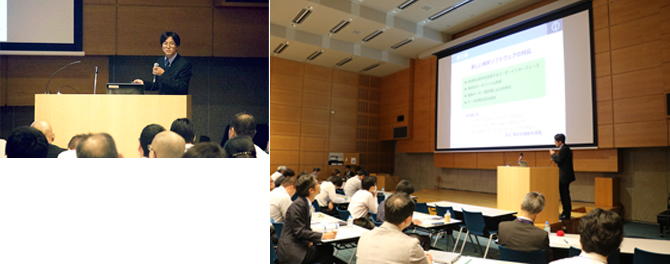
The materials presented by our company at the Technical Symposium (distributed materials) are available for download in the “Past Presentation Materials” section of the Club PHI instrument user member content, so please make use of this resource.
(Note: “Past Presentation Materials” is available exclusively to instrument user members. We ask for your understanding that Club PHI (general) members are not able to access this content.)
Related Product Links



Content for Club PHI Members
Those registered as Club PHI members can download various materials. (Content accessible may be restricted depending on membership type)
The following presentation materials are available exclusively to “Instrument User Members.”
2019 Technical Symposium (only our company’s presentations included)
- Introduction of the Latest Technologies Expanding the Possibilities of Surface Analysis — HAXPES — (PDF / 1,111.90 KB)
- Introduction of New Analysis Software Realizing a Comfortable Data Processing Environment and Automation (PDF / 8,164.18 KB)
Member registration is required to download.
We apologize for the inconvenience, but please register for membership here.