On Thursday, July 10, 2025, we held our Technical Symposium at Architectural Institute of Japan Hall (Tamachi, Tokyo).
Once again, many customers attended, and we received numerous positive comments for all presentations, including “It was very interesting,” “I hope this continues,” and “I would like to attend again.” The social gathering following the symposium was also well-attended, and the event concluded successfully in a warm and friendly atmosphere.
We would like to express our sincere gratitude once again to Mr. Toshio Suzuki of AGC Inc., Mr. Hideki Yoshikawa of the National Institute for Materials Science (NIMS), and Prof. Jiro Matsuo of Kyoto University Graduate School (in order of presentation).
> Click here for the program on the day
Lectures
“The Role of the Analysis and Characterization Division at AGC”
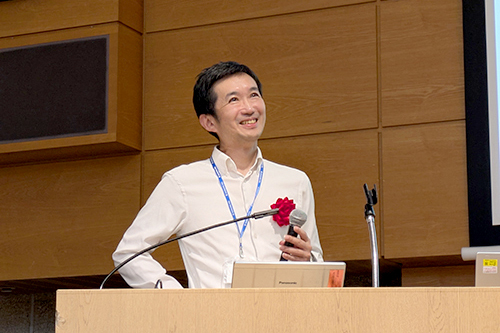
Mr. Toshio Suzuki,
Analysis Science Team, Common Foundational Technology Department, Advanced Base Research Institute, AGC Inc.
Mr. Suzuki of AGC Inc. delivered a lecture titled “The Role of the Analysis and Characterization Division at AGC,” covering the role that the analysis and characterization division plays within the company and its impact on society, as well as specific examples of how surface analysis has been utilized within the company.
The roles of the analysis and characterization division were described as follows: contributing to the improvement of development and processes through mechanism elucidation; promoting business (output) contribution through trial and error with a matrix organization consisting of an output axis (main unit) and a technology axis (sub-unit); actively engaging not only in analysis and characterization but also in technology development; and placing importance on outputs such as analysis reports, intellectual property creation, and external presentations (academic conferences and papers).
Regarding the application of C60 sputtering, an example was presented in which XPS depth profiling of a glass cross-section was performed to obtain surface profiles of modifier cations (such as Na ions), which are considered important in glass materials, making it possible to quantitatively understand the surface behavior of modifier cations. The lecture on the case in which XPS depth profiling of glass samples before and after corona discharge treatment enabled quantitative understanding of the surface treatment state and surface degradation (such as staining) was a very interesting topic.
“Utilization of Public Materials Data Platforms Using XPS as an Example and Future Prospects”
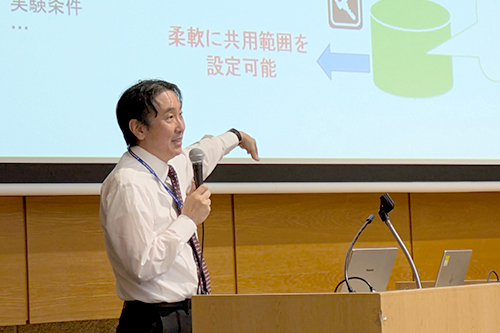
Mr. Hideki Yoshikawa
National Institute for Materials Science (NIMS)
Mr. Yoshikawa, who is active at the National Institute for Materials Science (NIMS), introduced efforts to automate data structuring that makes data output from instruments AI-ready — easier to apply machine learning to — using XPS spectra, which we handle on a daily basis, as an example.
NIMS is working on the formation of a “data core hub” for collecting, sharing, and utilizing materials research data under the Ministry of Education, Culture, Sports, Science and Technology’s “Materials DX Platform Initiative,” and provided a detailed introduction to DICE1, a group of data publication/sharing services provided by the hub. In particular, it was explained that the RDE2 service has the strength of reading daily experimental and computational work data as-is and automatically performing structuring processes that enhance the reusability of work data, and that it also supports the format of XPS spectra that we handle. It was also introduced that ARIM3, which accumulates usage data from shared instruments on a national scale, is advancing the development of a reliable data infrastructure through the standardization of instrument metadata and condition settings, and that DxMT4 is promoting efforts to demonstrate the effectiveness of data-driven methods using AI and other technologies for analyzing and utilizing accumulated data in advancing materials research.
It was a valuable lecture that inspired a desire to contribute to the development of metadata infrastructure and fostered expectations for the future of data utilization.
*1: A collective term for the materials research data publication/sharing cloud services provided by the NIMS Data Core Hub
*2: One of the DICE services, a system responsible for data collection, structuring, and sharing (Research Data Express)
*3: The Ministry of Education, Culture, Sports, Science and Technology’s Advanced Research Infrastructure for Materials and Nanotechnology (ARIM) program
*4: A materials research and development project that creates and utilizes data to lead new data-driven research (DxMT)
“SIMS: The Next Move”
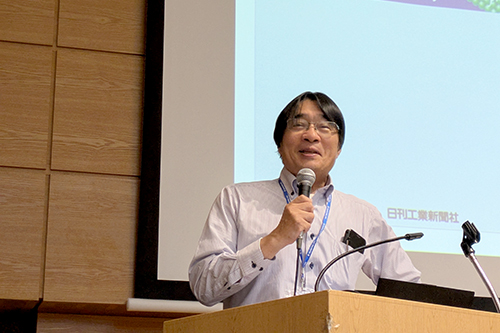
Prof. Jiro Matsuo
Kyoto University Graduate School
Prof. Jiro Matsuo of Kyoto University, internationally renowned as a pioneer in surface research using GGIB, delivered a lecture titled “SIMS: The Next Move,” covering the current status and challenges of SIMS technology and the latest research on improving signal intensity in mass spectrometry.
During the lecture, it was explained that SIMS using GCIB is expected to find applications in the life sciences field by leveraging its ability to perform non-destructive three-dimensional structural analysis and imaging; however, there remains a challenge to be overcome in that the signal intensity of low-molecular-weight drug molecules is very low, and the importance of improving secondary ionization yield was discussed. In particular, the logical derivation that a potential sensitivity enhancement of approximately 10⁵ times the current level is possible — based on calculated yields of organic molecules retaining their original molecular structure — was a new finding for us and was extremely interesting and impressive.
Prof. Matsuo’s lecture, which highlighted the challenges facing SIMS and reflected his own frontline engagement in SIMS technology development, resonated deeply with the users who attended, as well as with us — a company that develops, manufactures, and sells surface analysis instruments. It was also a truly valuable lecture that inspired us to continue evolving by building on the technologies that Prof. Matsuo has cultivated.
Thank you very much for the invaluable lectures.
From ULVAC-PHI
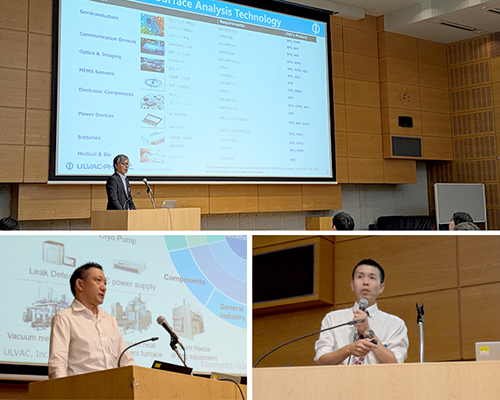
Our mission is to convert invisible phenomena into data through surface analysis technology and to provide information that directly supports our customers’ decision-making.
Surface analysis technology is also indispensable in the semiconductor and electronics fields. We are confident that by integrating ULVAC’s manufacturing process instruments with surface analysis-based evaluation, it will be possible to provide even more valuable solutions.
We will appropriately apply surface analysis techniques XPS, AES, and SIMS according to their respective strengths, while also supporting multimodal analysis that combines multiple techniques — essential for the increasingly complex analysis of materials and devices. Furthermore, we will promote the automation of data analysis utilizing AI, and strive to contribute to the succession of expert knowledge and the resolution of labor shortages.
There are still many challenges to address, such as demonstrating the validity of analysis results and identifying complex data, but great expectations are being placed on future technological development.
In addition to the support we have provided through our surface analysis instruments, we will make every sincere effort toward proposing solutions that look one step further ahead.